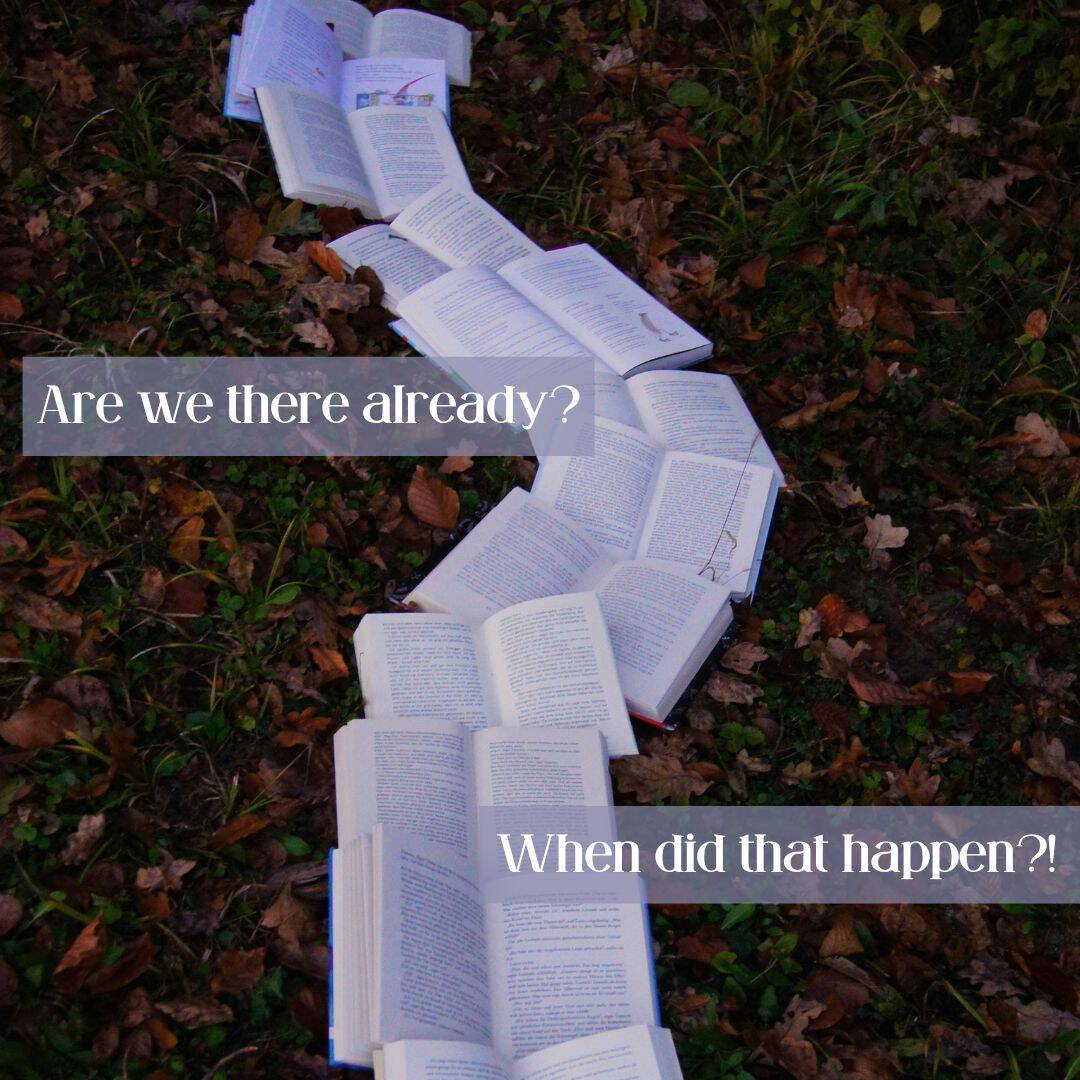
How can timing between books affect readers? Let’s consider some ways.
In this post I’m discussing a major issue I have with some book series. For the purpose of this discussion, I’m saying that a ‘series’ constitutes a group of books that maintain the same main characters throughout.
When an author is writing a series, they have many decisions to make. These decisions have a massive impact on the atmosphere and direction of the book and can really add to, or detract from, a reader’s enjoyment. The choice I’m highlighting here is how much time they allow to pass in the storyline between each book.
How important is timespan between books?
It’s hugely important, my friends. It can make a tremendous difference to the situations of your established characters; it also has a bearing on new characters that may have entered their lives off-page. If you go too far and change too much, your readers might feel totally disconnected and left behind.

To illustrate, let me share my personal experience. Years ago I read the first book in a mystery series (I won’t name names), and I really enjoyed it. There was a decent level of mystery, a unique main character and a nice element of romance. I felt invested enough to grab the next couple of books in the series. All was bright, shiny and generally delightful—until I started reading the second book.
What went wrong? All the carefully crafted romantic tension, the slow progression of the main characters going from thinking they never had a shot together to letting the hope of a potential relationship start to blossom, was thrown in the trash within the first few pages. Bear in mind that this tremulous relationship, this uncertain tension, was a reasonably big part of that first book.
But by book two, suddenly they’d been dating for months and were possibly even living together. The author skipped everything in between. First date, first kiss, even the first handshake. Everything of personal significance between them happened within a fade to black.
What’s the big deal?
I’ll tell you the big deal. When a story deliberately works to get you emotionally involved in the development of a relationship, it’s disappointing to bring it together off-page. All done and sorted out without including the hapless chump of a reader that stuck with you for most of the journey. And arguably the most arduous part of said journey. It’s like finding out that your friends threw a massive party and invited everyone but you. It’s startling and, frankly, rather impolite.
Am I exaggerating the issue? I don’t think so, not in this case. When it comes to pivotal plot points, authors need to carefully judge the risk of excluding the reader. I use the word ‘risk’ very genuinely here. If you catapult the story into the future and leave the reader scrambling to catch up, they may lose interest entirely.
For example, by the third book in that series, the couple had gone from dating to being married with two kids. I felt completely thrown out of the whole story. I lost interest in the characters and never picked up one of those books again.
Am I suggesting that no time pass between books? No, not at all, but tread with careful and measured steps. When crafting characters and cultivating a story, an author’s dream is for other people to enjoy that story and to love those characters as much as they do.
You invest a lot of time and effort into writing solid characters that other people can relate to. Why do all that and then skim over half the details you’d been trying to get readers emotionally invested in?
Why do some writers skip over key events?
There are several potential reasons. Maybe there are certain plot points they want to explore that require a chunk of time to have passed. Perhaps they want to keep the series short but still cover a larger portion of the character’s lives. Or, possibly, they aren’t naturally adept at putting those more tender or emotional moments into words. All are valid reasons for throwing your story into a time warp but, again, be careful and know the risks.
Not everyone will be as put off by a huge jump as I am. It’s just my personal taste as a reader. I’d rather an author followed the same characters more incrementally or just wrote a new story with new characters. And please bear in mind that I’m talking about a HUGE jump. Years, not weeks or even months. To me, it feels like meeting an old friend for coffee and hearing them talk about the spouse, job and kids you didn’t realize existed. You suddenly don’t feel close to that person anymore.
I will also note that there’s a difference when a series explores the lives of a family or a group of friends. Earlier this year I read a romance series that followed the exploits of the daughters in a large family. This spanned about 15 years all up, but the main characters shifted with each book and it didn’t seem as out of place. Also, their individual stories wrapped up sufficiently before moving on to the next.
But if I like the tone and characters in a book enough to want to continue on their adventures with them, I don’t want to feel like I have to get to know the same people again. They’ve moved on without me and I’m playing catch-up; I’m out of the loop. That’s my disgruntled reader reaction.

Other factors to consider
Looking at it from an author’s angle, it also feels like a waste of creative energy. It’s not the fastest or easiest thing in the realm of writing to nicely develop a town (or world). And then you need to fill it with good and likeable characters that other people enjoy. Once you’ve achieved that, particularly if a connected series is the plan, why throw it all in?
With that in mind, I have two preferred styles of writing when it comes to books that share some form of connection. If I’m writing a straight-up series, I try to keep the time between books fairly tight. Again, by ‘series’ I mean the main characters remain constant throughout.
For instance, in my Maiden Harlow cozy mysteries, there will be a total of 10 books. But the whole series will play out in the course of a year or so.
However, in my romantic fantasy books under my other pen name, there are shared worlds and themes but not all of the books are in a direct series. It sometimes doesn’t matter how much time passes because there aren’t always main characters carried from one book to the next.
Those are my preferred methods because I like to keep the reader with me. There are exceptions to everything, of course, but for the most part that’s a standard of how I write.
Is there anything wrong with jumping huge spans of time between books? Of course not, whatever method suits your style is as valid as any other. But I end up feeling left out and the author has to work extra hard to engage my interest again. That’s just me, and I doubt the fear of losing my meagre readership will keep anyone awake at night. But it’s a factor that I feel at least merits considering.
2 responses to “Timing Between Books-Does It Alienate Readers?”
-
Interesting!
-
Thank you for reading! 😁
-


Have a thought to share?